
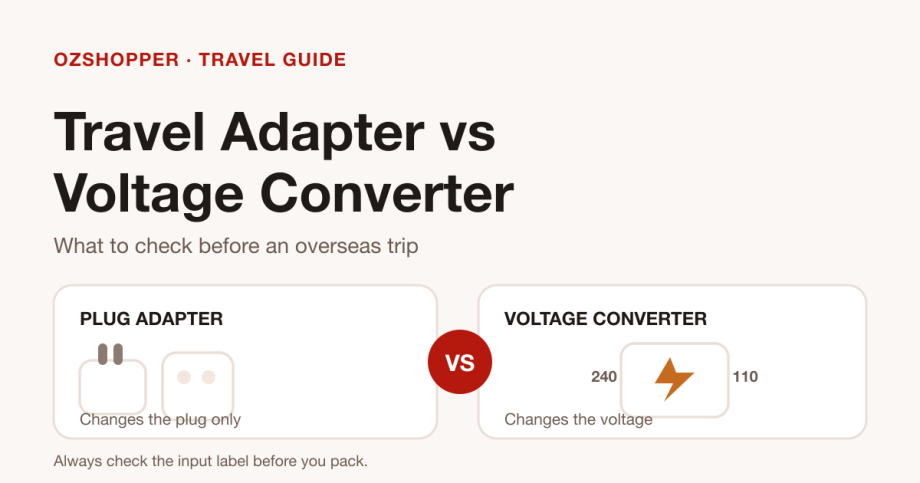
Short answer: a plug adapter only changes the shape of the plug so it fits the wall socket. It does not convert voltage. A voltage converter (sometimes called a transformer) changes the electricity itself — for example, stepping 240V down to 110V. Pack the wrong one and you can end up with a dead device, a blown fuse or a safety risk. Before you fly, check three things: your device’s input-voltage label, the plug type used at your destination, and what each device actually needs to charge.
Adapter vs converter: the difference in one line
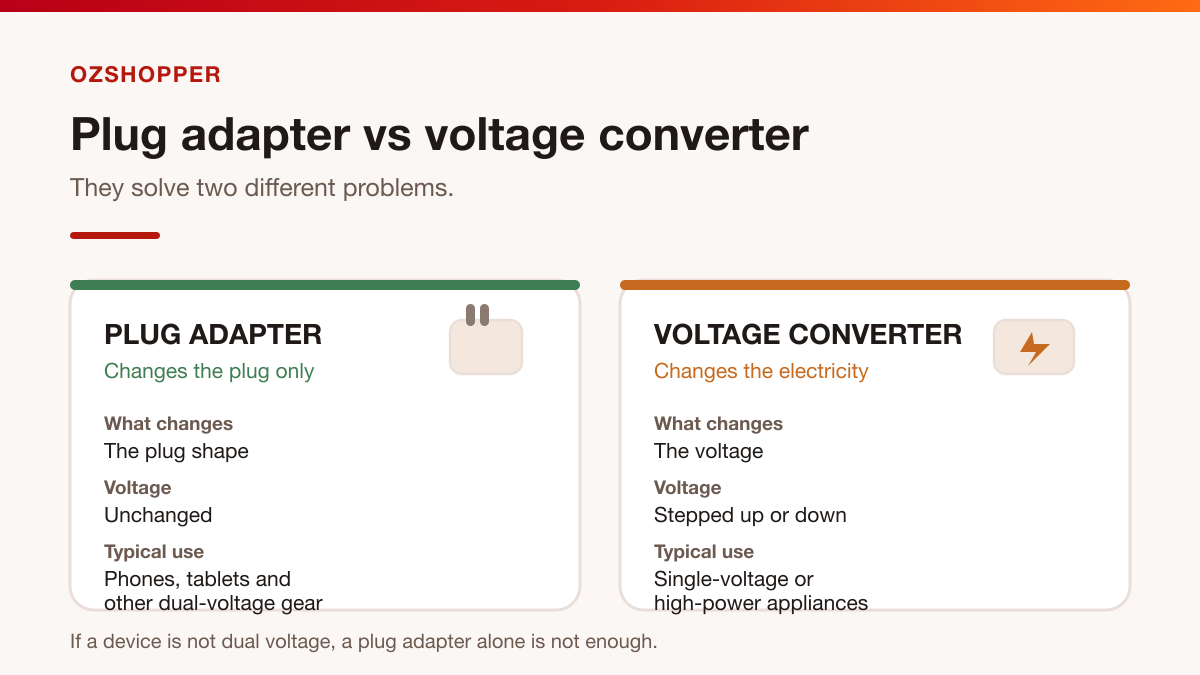
A plug adapter re-shapes the connection. A converter changes the voltage.
- Plug adapter: matches a different wall socket. The voltage passes straight through unchanged.
- Voltage converter / transformer: changes the voltage, for example 240V to 110V. Needed by single-voltage appliances.
- Dual-voltage device: built to run on a range (commonly 100–240V). Usually it just needs the right plug, not a converter.
Step 1 — Read the label on the device or its charger
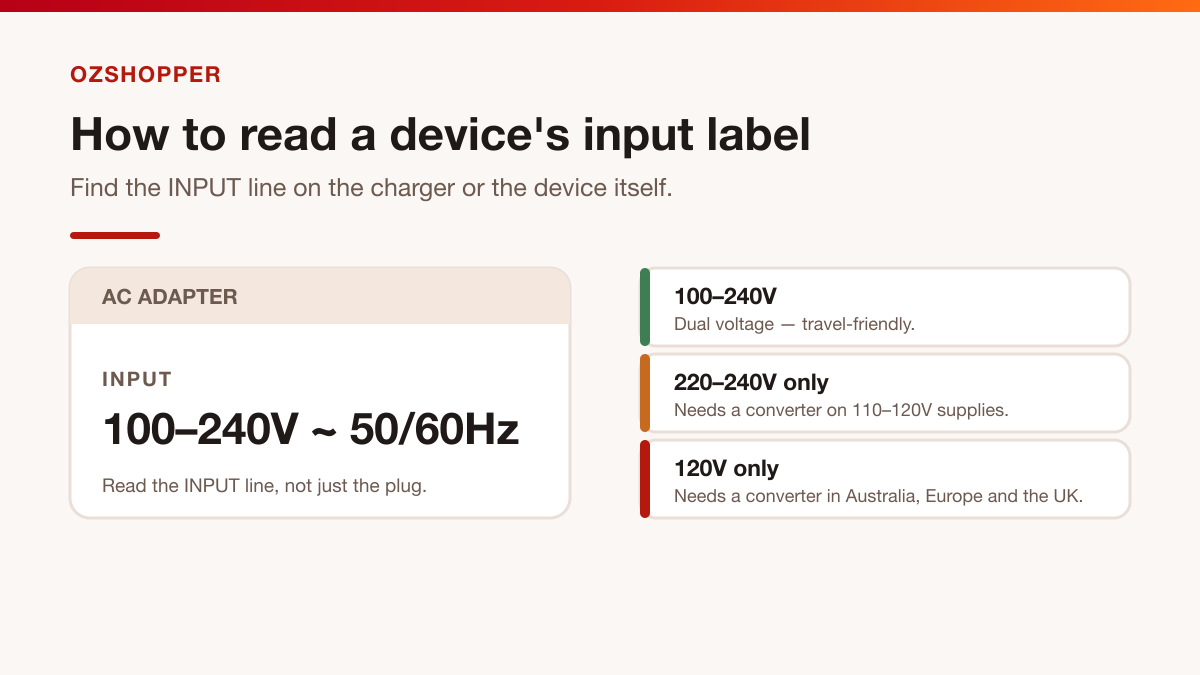
This is the most useful five-second check you can do. Look for the Input (or INPUT) line on the device, its charger or its power brick.
- Voltage (V): 100–240V means dual voltage and travel-friendly. 220–240V only will not run on a 110–120V socket without a converter. 120V only needs a converter for Australia, Europe, the UK and much of Asia.
- Frequency (Hz): 50/60Hz is fine in most countries. Some 50Hz-only motors, such as older clocks or hair tools, can run fast or hot on 60Hz.
- Power (W) or current (A): higher-wattage items draw more current and need more care.
Step 2 — Find out which plug type your destination uses
Plug shapes vary far more than people expect, and a trip through several countries can mean several types.
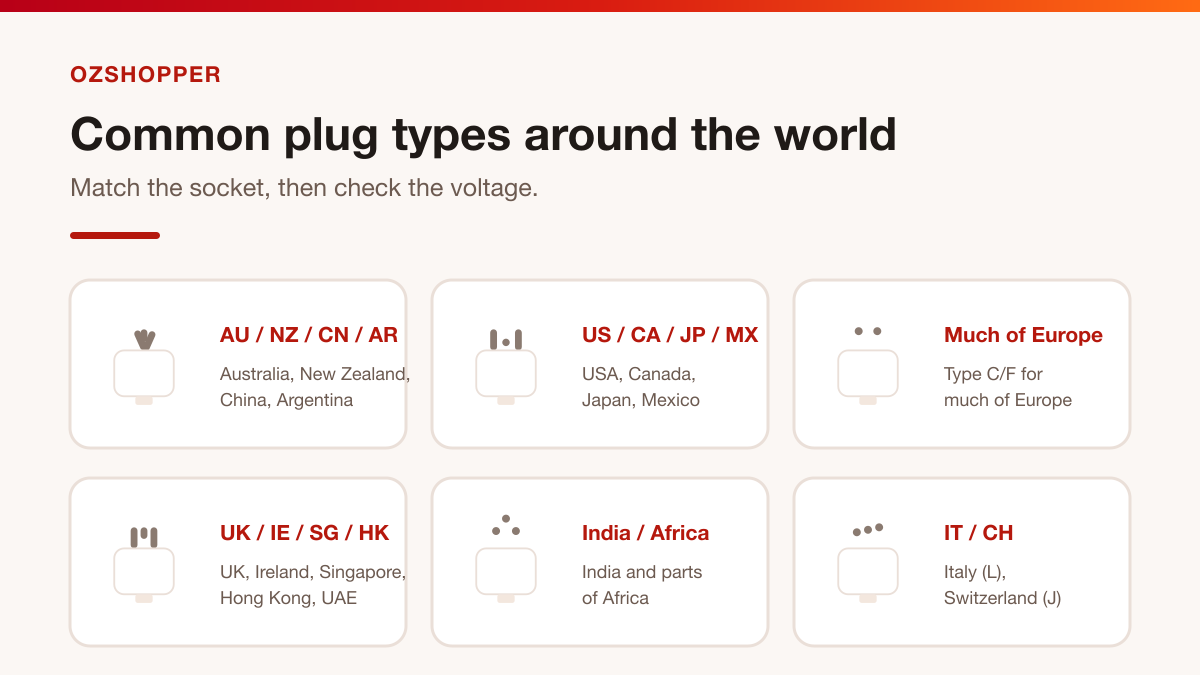
- Type I: Australia, New Zealand, China, Argentina
- Type A/B: USA, Canada, Japan, Mexico
- Type C/F: much of Europe
- Type G: UK, Ireland, Singapore, Hong Kong, UAE
- Type D/M: India and parts of Africa
- Others: Italy (L), Switzerland (J), Thailand and parts of Africa (O), Israel (H), South Africa (M/N)
A universal travel adapter combines several plug shapes in one unit, which is handy when one trip crosses borders.
Step 3 — Match your gear to the power it needs
Not everything in your bag has the same appetite for electricity.
- USB devices (phones, tablets, earbuds, smartwatches, cameras) are almost always dual voltage and charge from USB, so the plug and enough USB ports matter most.
- Laptops: check the charger brick. Many are dual voltage, but not all. A USB-C laptop charger is usually dual voltage — read the label to be sure.
- Hair dryers, straighteners, kettles and travel irons are often single voltage and high power. These are the items most likely to need a converter, and the ones least suited to a small plug adapter. Dual-voltage travel versions or the hotel’s own appliance are usually the safer choice.
- Medical devices such as a CPAP machine: check with the manufacturer before you travel.
What a universal travel adapter is good for
A universal adapter is a connection tool, not a power converter. Used within its limits, it is the simplest way to charge a bag full of USB gear from one socket.
OZShopper’s Universal Travel Adapter with 2 USB-C + 2 USB-A in black and the matching green version each pair an AC outlet with two USB-C and two USB-A ports, so one socket can charge several devices at once. Both colours are described as plug adapters rather than voltage converters, which is worth remembering if you are travelling with a single-voltage appliance. For phones, tablets, earbuds, watches and dual-voltage laptop chargers, a multi-port adapter like this means you can leave a few separate chargers at home.
A quick pre-trip packing checklist
- Check the input label on every device and charger (voltage, Hz and watts).
- Note which plug types you will meet in each country on your itinerary.
- Sort your gear into “dual voltage” and “single voltage” piles.
- For single-voltage or high-power items, decide whether you need a converter or a different device.
- Pack one multi-port universal adapter for shared USB charging.
- Carry a spare fuse if your adapter uses one, and read the product notes.
- Keep chargers and cables in your carry-on, not checked luggage.
- Charge a power bank before you leave, and keep it in the cabin.
- Save a photo of each device label in case of a warranty claim.
Frequently asked questions
Can I use an Australian appliance overseas with just a plug adapter?
Only if it is dual voltage (for example, 100–240V). If it is 220–240V only, it cannot run on a 110–120V socket, and a plug adapter will not change that. Those devices need a converter.
Do I need a converter for my phone or laptop?
Most phones, tablets and USB chargers are dual voltage, so a plug adapter or a USB travel adapter is usually enough. Laptops vary, so check the charger’s input label — if it lists a range such as 100–240V, it is travel-friendly.
Can I use a small universal adapter with a hair dryer or kettle?
These are high-power, often single-voltage appliances and usually need a proper converter, not just a plug adapter. Read the device’s wattage and the adapter’s rating first; the wrong combination is a common cause of overloaded sockets and blown fuses.
The short version
An adapter changes the plug; a converter changes the voltage. Read the input label, check your destination’s plug type, and sort your gear into dual-voltage and single-voltage before you pack. Do that, and the only thing left to plan overseas is what to see next.